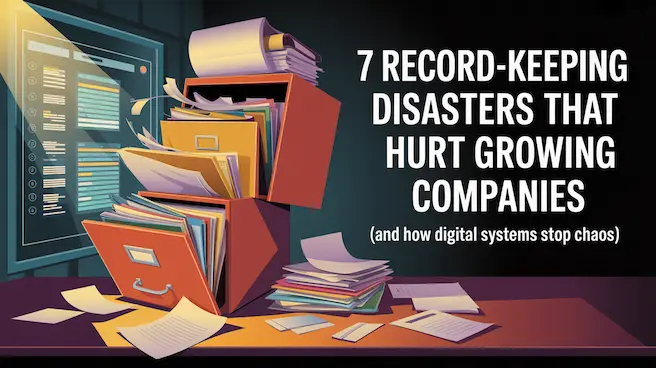
7 Record-Keeping Disasters That Hurt Growing Companies and How Digital Systems Stop Chaos
By the end of this article, you will know how to turn your business’s weaknesses into strengths.
Your record-keeping system can either boost or hinder your growth. Many leaders discover this after encountering one of seven common disasters. The right digital tools could have avoided these issues. Turning chaos into clarity is possible and essential with the right systems.
This article will help you avoid costly mistakes. It will also show you how to build strong operational foundations that grow with your needs.
The Hidden Cost of Manual Madness
Manual record-keeping seems fine until it fails you at a critical moment.
I learned this lesson early in my career. A small invoice error almost cost me a major client. I’ve watched many businesses succeed or fail over the years. I’ve seen that data management is often the key difference. Michael Gerber says, “The systems run the business, and the people run the systems.” If your systems fail, your team will struggle.
Successful businesses know that digital record-keeping is about more than compliance. It creates the clarity needed for smart decisions.
Disaster #1: The Great Audit Avalanche
Lost documents during audits cause compliance problems, hurt credibility, and waste time.
Sarah Henderson owns a manufacturing business. She realized this when officials asked for five years of supplier records. Her filing cabinets had incomplete documents and faded receipts. The process used 200 hours of senior staff time. It also resulted in penalties that could have paid for a digital upgrade. Modern digital systems keep audit trails and provide quick access to historical data.
With digital systems, audits become simple tasks instead of crises.
Disaster #2: The Departmental Data Disconnect
Inconsistent information across departments creates confusion when leaders need clarity.
I’ve seen companies where sales, finance, and operations all have different numbers. Marketing reported 1,000 new customers. Customer service received 1,200 support tickets from “new users.” This isn’t due to incompetence; it stems from manual systems that keep separate records. Digital integration helps all departments use the same data. This cuts down on confusion and boosts growth.
Unified digital systems turn silos into collaborative teams working toward common goals.
Disaster #3: The Time-Sucking Data Entry Death Spiral
Manual data entry errors multiply, wasting valuable executive time.
Companies that spend more than 20% of their time fixing manual data grow 50% slower. A simple typo can lead to incorrect invoices, delayed payments, and flawed reports. I’ve seen finance teams spend days fixing these errors. The hidden cost isn’t time; it’s missed growth opportunities.
Digital automation prevents data entry errors right away. This allows your team to focus on growth instead.
Disaster #4: The Real-Time Information Blackout
Delays caused by outdated information create long-term competitive disadvantages.
Business strategy needs timely information, but manual systems often provide outdated snapshots. Successful leaders make small adjustments based on real-time feedback. Companies relying on old reports miss chances that others seize instantly. Digital dashboards provide real-time updates on cash flow and market trends. This helps leaders act quickly and stay ahead.
Real-time digital insights help leaders make informed decisions with current data.
Disaster #5: The Compliance Reporting Catastrophe
Last-minute compliance rushes can lead to penalties and damage relationships.
Governance needs timely and accurate reports. But manual systems can take weeks to prepare. I remember a client who discovered a compliance deadline 72 hours before it was due. Their manual system couldn’t generate the necessary reports without reconstructing months of data. The penalties were steep, but the reputational damage was worse. Digital systems keep documentation ready, allowing for quick report generation.
Automated compliance reporting makes regulatory tasks routine instead of stressful.
Disaster #6: The Resource Duplication Drain
Many people doing the same tasks create hidden inefficiencies that worsen with growth.
Without centralized digital systems, team members often duplicate work. Customer service might re-enter data already recorded by sales. This duplication wastes time and creates inconsistencies. Peter Drucker said, “Efficiency means doing things right. Effectiveness is about doing the right things.” Without digital tools, teams find it hard to notice the difference.
Digital workflows help teams finish tasks on time. They also ensure that everyone documents them in a correct manner.
Disaster #7: The Decision Trail Disappearance
Missing documentation for business decisions creates risks and hinders learning.
When decisions lack proper records, businesses lose valuable knowledge. In my consulting years, I noticed firms struggled to explain their strategic choices. This made it tough for them to repeat success or steer clear of mistakes. Legal issues become tricky without documented decision processes. Digital systems track decision trails. They show who made choices and which data they used.
Solid digital documentation protects your business and helps improve decision-making.
The Digital Transformation Blueprint
Moving from manual chaos to digital clarity requires planning but yields great results.
Assess your current information flows. Examine the locations where someone enters, stores, or retrieves data by hand. Track critical information from capture to reporting, noting every potential error point. Focus on digitization based on risk and time consumption, not everything at once. Choose integrated solutions to prevent new data silos. Train your team on new processes. This helps everyone grasp the technical and strategic benefits.
Switching to digital record-keeping is more than an upgrade. It gives you a competitive edge that will increase over time.
Your Implementation Questions
These questions will help you tailor digital transformation to your business:
Assessment Questions: What manual processes take the most executive time? Which information gaps cause the biggest decision delays? Where do data inconsistencies create the most friction? What compliance issues stress your team the most?
Priority Questions: Which digital improvements would deliver immediate time savings? What automated systems would reduce your biggest operational risks? Which integrated solutions would cut the most duplicate work? How could real-time reporting change your strategic decision-making process?
Implementation Questions: What training would your team need to maximize digital system benefits? Which current processes should we cut rather than digitize? How will you measure the success of digital transformation initiatives? What backup systems will protect against technology failures?
The Authority of Experience
This strategy comes from 40 years of business experience. It includes early tech development and guiding companies through digital changes.
I started my journey with hands-on work in electronics and computer systems. Then, I built and scaled several businesses. Finally, I refined my skills by consulting for companies facing similar challenges. Businesses using digital record-keeping usually perform better than those relying on manual methods. To succeed, you need to know the technical skills and the human factors that impact the outcome. Successful companies don’t just use new technology. They also redesign their workflows to fit digital tools.
Digital transformation works best when it solves real operational problems. It shouldn’t just swap familiar manual tasks for new digital ones.
Disclaimer: This article shares my insights from 40 years in business and tech. The information provided is anecdotal and for educational purposes only. Before you make business changes or start digital transformation, talk to experts. Contact consultants, accountants, legal advisors, or tech specialists who meet your needs. Their advice can guide you. The author is not responsible for any decisions made based on this content. Your experience may differ from the examples provided.
Choose between operational chaos and digital clarity. This decision will impact every future choice your business makes. Your competitors are already making their choices.