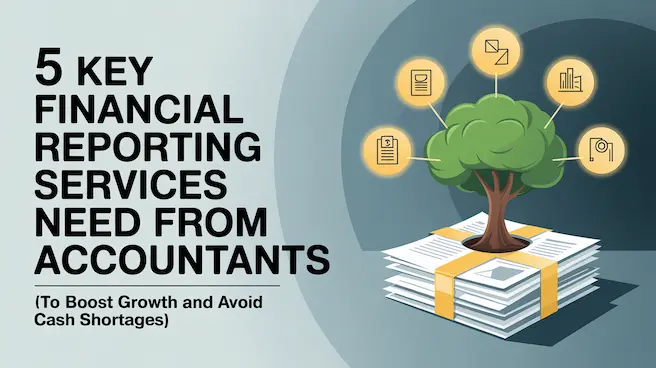
5 Key Financial Reporting Services CEOs Need from Accountants to Boost Growth and Avoid Cash Shortages
The numbers on your screen tell a story, but are you interpreting them accurately?
In my 40 years in business, I’ve seen many savvy entrepreneurs stumble due to financial blindness. They chase revenue while cash slips away. They celebrate monthly successes while quarterly issues build up. In my cybersecurity job, I help businesses grow. I’ve learned that solid financial planning is key to success.
Growth without financial clarity is like driving blindfolded at midnight.
Service 1: Management Accounts That Manage
Your monthly management accounts should predict problems, not just report them.
Good accountants create systems. These systems identify trends, pinpoint profit leaks, and reveal growth opportunities early. They track revenue streams and measure performance against strategic goals. In my phone marketing role with large companies, I conduct monthly reviews. They show trends in quarterly results.
Management accounts turn past data into strategic insights.
Top accountants provide reports within 10 days after the end of each month. This gives crucial insights for quick decision-making. They design dashboards to meet different needs. Department heads get detailed metrics. Boards receive strategic summaries. Investors see trend analyses.
Late financial reports are like weather forecasts delivered after the storm.
Service 2: Cash Flow Forecasting That Prevents Disasters
Your cash flow forecast is your survival map.
Expert accountants build 13-week cash flow models. These models account for seasonal changes, payment terms, and growth investments. They prepare for the best, worst, and likely scenarios. Good cash flow forecasting helps prevent panic-driven decisions that can harm businesses.
Cash flow problems kill more businesses than competition ever will.
Professional forecasting includes:
- Weekly cash position tracking with daily updates during critical times.
- Customer payment pattern analysis to spot slow accounts.
- Supplier payment optimization to balance cash needs with relationships.
- Investment timing coordination to avoid cash crises. Predictable cash flow enables predictable growth.
Service 3: Profit & Loss Analysis That Drives Decisions
Your P&L should reveal not just what happened, but also why.
Accountants skillfully make profit and loss (P&L) statements. These statements show performance by product lines, customer groups, and business units. They work out contribution margins. They also keep an eye on costs and measure key indicators that relate to profitability. From my advisory work, I learned that detailed P&L analysis can reveal surprising truths.
The most profitable customers aren’t always the biggest spenders.
Advanced P&L reporting includes:
- You need to analyze the gross margin for each product or service. This helps you see which ones make a profit.
- Customer acquisition cost tracking ensures that marketing pays off.
- Operational efficiency metrics identify process improvements.
- Comparative period analysis to spot trends before they become issues. Profitable decisions need profitable insights.
Service 4: Variance Analysis That Explains Reality
Your budget variance reports should tell stories, not just show numbers.
Accountants compare planned performance with actual results. They look for the reasons behind any gaps and suggest actions to improve. They distinguish between short-term changes and long-term problems. This helps you respond effectively to changes. From my years in business, I learned that identifying variance patterns is key. It matters more than just celebrating those rare wins.
Variance analysis turns surprises into strategic advantages.
Quality variance reporting examines:
- Revenue variations by source, timing, and market conditions.
- Cost fluctuations distinguish between controllable and uncontrollable factors.
- Operational metrics link financial results to business activities.
- Analyze market influence to distinguish between internal performance and external factors. Using systematic variance analysis prevents reactive decisions.
Service 5: Strategic Financial Modeling for Growth
Your financial models should guide scaling decisions, not just justify them.
Accountants who think ahead create models to test growth scenarios. They also check investment options and predict resource needs. They explore different expansion strategies, assess break-even points, and calculate returns on investment. My career has shown me that proper financial modeling prevents costly scaling mistakes.
Strategic modeling turns growth from a gamble into a calculated investment.
Your Questions for Accountant Selection
When assessing financial reporting, consider these critical questions:
- Reporting Timeliness: Can they send management accounts within ten business days?
- Forecasting Accuracy: How accurate are their cash flow predictions?
- Analysis Depth: Do they offer insights beyond basic reports?
- Technology Integration: Can it automate data collection and reports?
- Strategic Understanding: Do they understand your business model and growth goals?
Your Path Forward
Numbers don’t lie, but they need interpretation.
Transparent financial reporting converts data into key insights. This empowers confident scaling decisions grounded in reliable patterns.
The proper framework provides early warnings, opportunities for optimization, and growth plans. These help turn big goals into reachable milestones. This reflects my experience.
Always seek professional advice tailored to your situation, as circumstances may differ.
Your success in scaling depends on the quality of the financial insights you get today.
Disclaimer: This article shares my personal experiences and is not professional advice.
Always consult qualified accounting professionals for guidance specific to your situation. The author accepts no liability for decisions made based on this content.