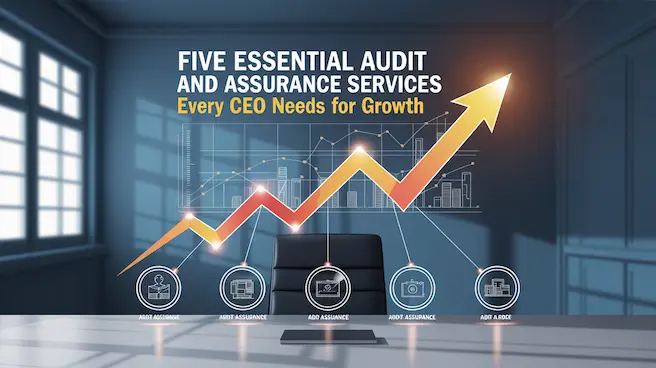
Five Essential Audit and Assurance Services Every CEO Needs for Growth
Incorrect financial statements can erode investor trust and harm your business.
In my 40 years in business, I’ve seen many talented entrepreneurs lose it all due to sudden compliance problems. An accounting mistake can lead to a regulatory investigation. A weak internal control can open the door to fraud. An audit failure can undermine stakeholder trust. Strong audits and assurance drive growth in my cybersecurity and business advisory services. They are like a skyscraper needing a solid foundation.
Scaling without audit assurance is like building wealth on shaky ground.
Service 1: External Audit Services That Uphold Credibility
Your external audit is a badge of credibility for your business.
Professional accountants conduct external audits that verify financial statements and compliance. They prepare your business for audits and handle the process smoothly. In my experience, large companies often identify problems during the audit preparation process. This helps stop issues from getting worse.
External audits turn financial statements into trusted market credentials.
Key elements of external audit coordination include:
- Prepare for audit readiness to ensure all documents and controls meet the standards.
- Stakeholder communication is to keep investors and regulators informed.
- Control testing helps to prove the effectiveness of internal controls.
- Management letter response to address audit findings and make improvements.
Effective audit coordination transforms regulatory requirements into competitive advantages.
Service 2: Internal Audit Functions That Prevent Issues
Your internal audit system acts as an early warning for risks.
Skilled accountants create internal audits. These audits track processes and assess the effectiveness of control implementation. They identify compliance risks before they turn into problems. Effective internal auditing can help avoid external compliance issues.
Internal audits catch issues while they’re manageable, not after they become crises.
Core internal audit services include:
- Process evaluation to find efficiency gains and control gaps.
- Compliance monitoring to check adherence to rules and policies.
- Fraud prevention through controls and monitoring systems.
- Risk assessment suggests improvements and reduces risks.
Internal audits turn hidden risks into opportunities for growth.
Service 3: Financial Statement Assurance That Boosts Trust
Your financial statement assurance builds trust in your business reports.
Accountants with experience offer compilation, review, and assurance services. These help make financial statements more credible. They ensure accuracy and compliance with accounting standards. In my advisory work, I’ve found that solid financial statements boost credibility. This, in turn, helps in getting capital and finding new opportunities.
Financial statement assurance enhances the value of internal reports for external stakeholders.
Components of assurance services include:
- Compilation services for professional financial statement preparation.
- Review engagements that provide limited assurance through checks.
- Agreed-upon procedures for targeted testing based on needs.
- Special-purpose reporting for specific transactions or compliance.
Professional assurance turns financial data into trusted business insights.
Service 4: Compliance Audit and Regulatory Assurance
Your compliance audit should meet industry regulations and standards.
Accountants establish compliance audit programs to verify adherence to regulations and governance standards. They show evidence of compliance effectiveness. From what I’ve seen, regulatory compliance often takes precedence over operational success.
Compliance audits confirm your claims before regulators check them.
Compliance protection includes:
- Regulation checks for industry-specific requirements.
- Governance assessments of board oversight and control.
- Data protection compliance follows privacy laws.
- Quality management audits verify compliance with standards.
Compliance assurance turns regulatory needs into competitive strengths.
Service 5: Risk Assessment and Management Assurance
Your risk assurance system should identify and track threats to operations.
Forward-thinking accountants create risk assessment programs that check financial, operational, and strategic risks. They ensure risk management systems work effectively, helping businesses mitigate risks early. My experience shows that systematic risk assessment can prevent issues before they escalate.
Risk assurance turns unknown threats into manageable business strategies.
Risk management assurance includes:
- Enterprise risk assessments for strategic and operational risks.
- Control environment evaluation of management effectiveness.
- Business continuity assurance for disaster planning.
- Strategic risk monitoring to track market threats.
Comprehensive risk assurance safeguards current operations and future growth.
Questions for Choosing an Accountant
When assessing audit and assurance options, consider these questions:
- Audit Experience: Do they have experience working with businesses like yours?
- Regulatory Knowledge: Do they understand the compliance needs of your sector?
- Technology Use: Can they use technology for efficient audits?
- Communication Skills: Do they communicate clearly with stakeholders?
- Risk Awareness: Can they identify risks specific to your business model?
Your Next Steps
Every business decision creates an audit trail that shapes your credibility.
Professional audit and assurance services turn business operations into trustworthy enterprises. This enables confident growth through solid compliance and control. A robust assurance framework fosters trust, complies with regulations, and enhances efficiency. This helps governance gain a competitive edge. This reflects my experience, but I always recommend seeking tailored professional advice.
Your business legacy relies on the assurance you establish now.
Disclaimer: This article shares personal insights from four decades in business. It is not professional advice. Always consult qualified accounting and assurance professionals for guidance specific to your situation. The author accepts no liability for decisions made based on this content.